
Every Champion · Every Final · Every Star Player
1930 to 2022 | 22 Tournaments | 8 Different Winners
The FIFA World Cup — first held in Uruguay in 1930 — is the greatest sporting event on earth. Every four years, the world stops to watch 32 nations compete for football's ultimate prize. Over 22 tournaments across 92 years, only eight nations have ever lifted the trophy. This is the complete story of every champion, every winning manager, every star performer, and what those squads were worth.
From Uruguay's pioneering triumph on home soil in 1930, through Italy's controversial back-to-back victories under Mussolini's shadow, to Brazil's samba-football revolution in the 1950s and 60s, Germany's ruthless efficiency, Argentina's Maradona-inspired genius, and the modern era's astronomical squad values — this report covers it all.
Whether you are seeking historical context, betting angles on international tournaments, or simply the definitive reference guide, this is your complete World Cup bible.
Brazil lead the all-time standings with five titles — more than any other nation. Germany and Italy are joint second with four each. Together, these three nations account for thirteen of the twenty-two World Cups contested.
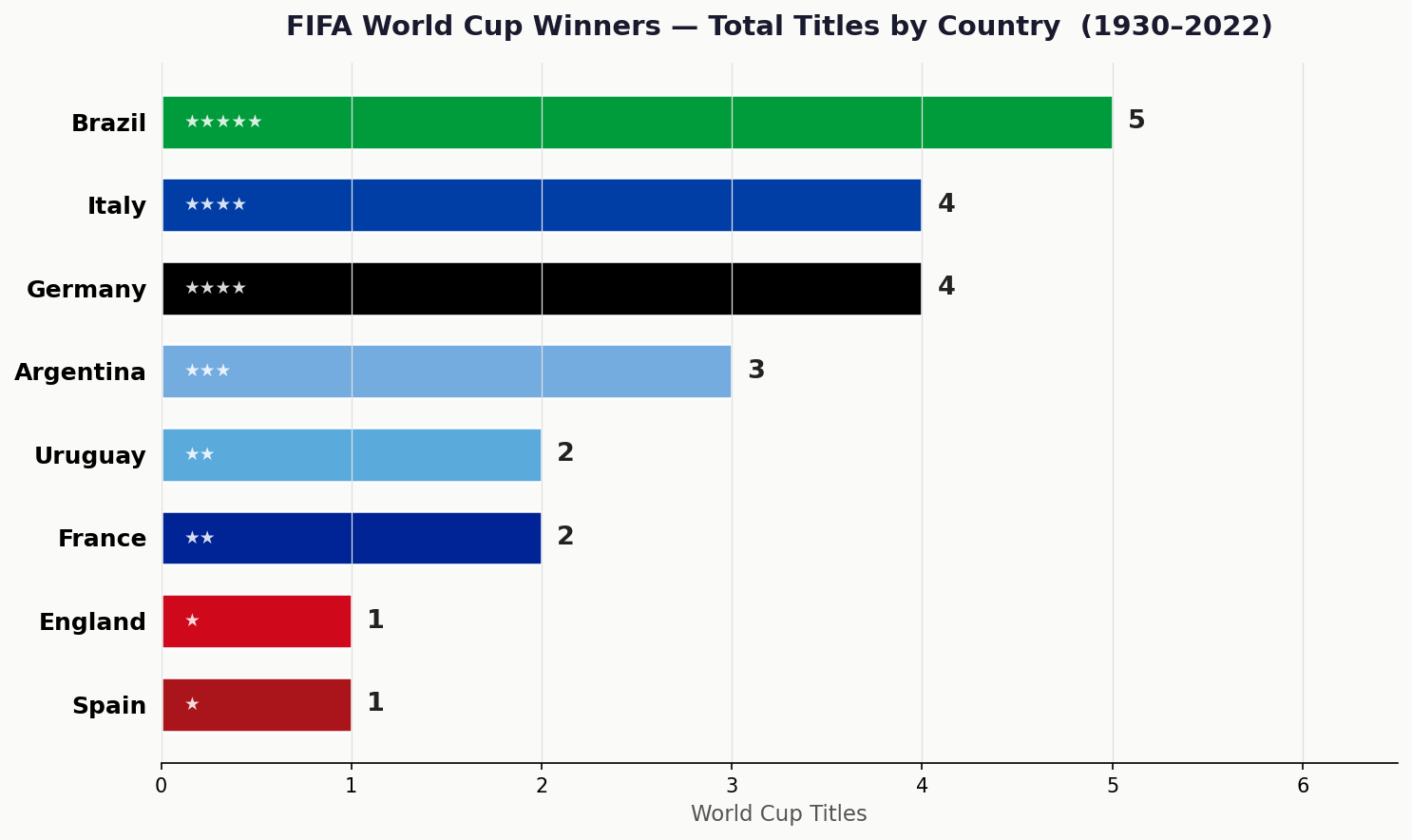
Figure 1: FIFA World Cup titles by country (1930–2022). Brazil lead with 5, followed by Germany and Italy with 4 each.
|
Country |
Titles |
Years Won |
|
Brazil |
5 |
1958, 1962, 1970, 1994, 2002 |
|
Germany |
4 |
1954, 1974, 1990, 2014 |
|
Italy |
4 |
1934, 1938, 1982, 2006 |
|
Argentina |
3 |
1978, 1986, 2022 |
|
France |
2 |
1998, 2018 |
|
Uruguay |
2 |
1930, 1950 |
|
England |
1 |
1966 |
|
Spain |
1 |
2010 |
The dominance of European and South American nations is total — no team from Africa, Asia, or North America has ever won the World Cup, though Japan (2002), South Korea (2002), and Morocco (2022) have reached the semi-finals in recent tournaments, hinting at a narrowing gap.
The World Cup has only ever been won by European or South American nations. Of the 22 tournaments, Europe has claimed 12 and South America 10. It is the most enduring rivalry in sport — and it has produced the most memorable finals.
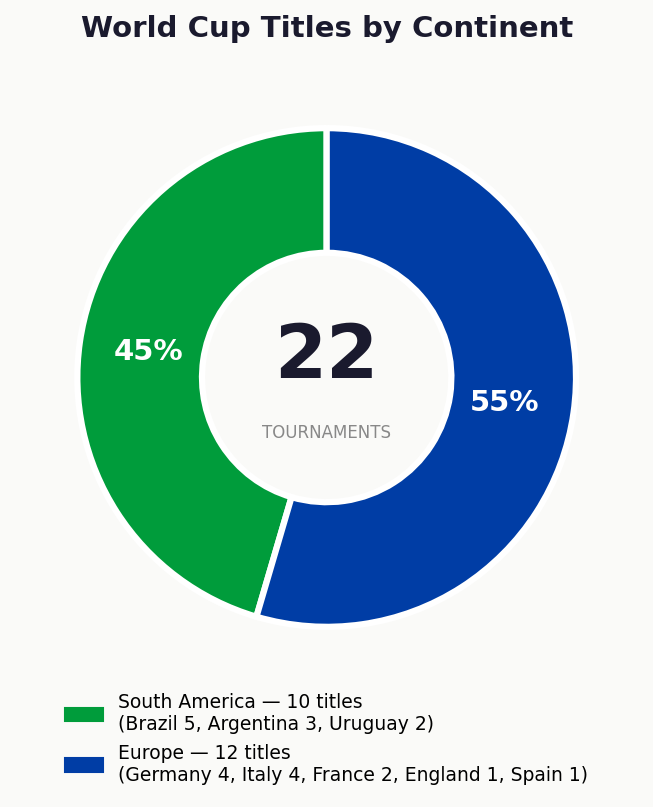
Figure 2: World Cup titles split by continent — Europe (12) vs South America (10). No other continent has ever won.
No team from outside Europe or South America has ever won a World Cup. In 22 attempts, the trophy has never crossed to another continent.
This visual map shows every World Cup winner plotted by year. Brazil's five wins are spread across four decades — the most geographically spread dynasty in the tournament's history. Germany's four titles cluster around the 1950s–70s and 1990s–2010s, while Argentina's three wins span 44 years from 1978 to 2022.
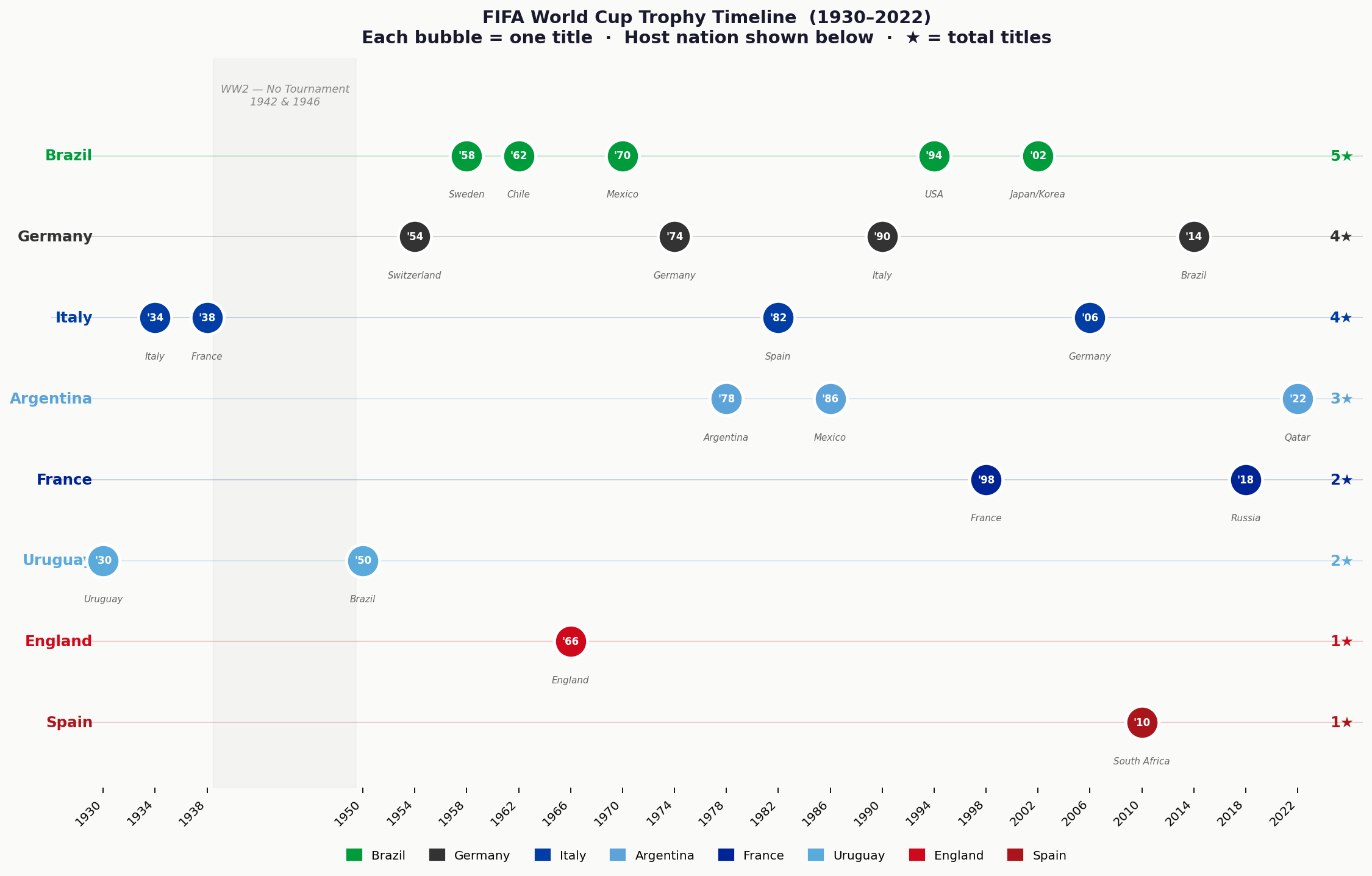
Figure 3: World Cup trophy timeline (1930–2022), showing which nation won each tournament. Bubble colour indicates the winning country.
The tournament was suspended from 1938 to 1950 due to World War II — a 12-year gap that robbed football of what would have been some of its most competitive competitions. When Brazil hosted in 1950, the format was a final round-robin rather than a knockout final — making Uruguay's famous 'Maracanazo' victory even more dramatic.
Every World Cup champion since 1930 — host nation, winner, manager, star player, final opponent, score, teams in the tournament and estimated squad value. Green margin scores = comfortable wins. Gold cells = penalty shootout finals.
|
Year |
Host |
Champion |
Manager |
Star Player |
Final Opponent |
Score |
Teams |
Est. Value |
|
1930 |
Uruguay |
Uruguay |
Alberto Suppici |
Jose Nasazzi |
Argentina |
4-2 |
13 |
£0.5m |
|
1934 |
Italy |
Italy |
Vittorio Pozzo |
Giuseppe Meazza |
Czechoslovakia |
2-1 |
16 |
£1m |
|
1938 |
France |
Italy |
Vittorio Pozzo |
Silvio Piola |
Hungary |
4-2 |
15 |
£1.5m |
|
1950 |
Brazil |
Uruguay |
Juan Lopez |
Obdulio Varela |
Brazil |
2-1 |
13 |
£2m |
|
1954 |
Switzerland |
Germany |
Sepp Herberger |
Fritz Walter |
Hungary |
3-2 |
16 |
£3m |
|
1958 |
Sweden |
Brazil |
Vicente Feola |
Pele |
Sweden |
5-2 |
16 |
£4m |
|
1962 |
Chile |
Brazil |
Aymore Moreira |
Garrincha |
Czechoslovakia |
3-1 |
16 |
£5m |
|
1966 |
England |
England |
Alf Ramsey |
Bobby Moore |
Germany |
4-2 |
16 |
£8m |
|
1970 |
Mexico |
Brazil |
Mario Zagallo |
Pele |
Italy |
4-1 |
16 |
£12m |
|
1974 |
Germany |
Germany |
Helmut Schoen |
Franz Beckenbauer |
Netherlands |
2-1 |
16 |
£18m |
|
1978 |
Argentina |
Argentina |
Cesar Menotti |
Mario Kempes |
Netherlands |
3-1 |
16 |
£25m |
|
1982 |
Spain |
Italy |
Enzo Bearzot |
Paolo Rossi |
Germany |
3-1 |
24 |
£35m |
|
1986 |
Mexico |
Argentina |
Carlos Bilardo |
Diego Maradona |
Germany |
3-2 |
24 |
£55m |
|
1990 |
Italy |
Germany |
Franz Beckenbauer |
Lothar Matthaus |
Argentina |
1-0 |
24 |
£90m |
|
1994 |
USA |
Brazil |
C.A. Parreira |
Romario |
Italy |
0-0* |
24 |
£130m |
|
1998 |
France |
France |
Aime Jacquet |
Zinedine Zidane |
Brazil |
3-0 |
32 |
£280m |
|
2002 |
Japan/Korea |
Brazil |
Luiz F. Scolari |
Ronaldo |
Germany |
2-0 |
32 |
£380m |
|
2006 |
Germany |
Italy |
Marcello Lippi |
Fabio Cannavaro |
France |
1-1* |
32 |
£520m |
|
2010 |
South Africa |
Spain |
Vicente del Bosque |
Andres Iniesta |
Netherlands |
1-0 |
32 |
£650m |
|
2014 |
Brazil |
Germany |
Joachim Low |
Manuel Neuer |
Argentina |
1-0 |
32 |
£750m |
|
2018 |
Russia |
France |
Didier Deschamps |
Kylian Mbappe |
Croatia |
4-2 |
32 |
£1,050m |
|
2022 |
Qatar |
Argentina |
Lionel Scaloni |
Lionel Messi |
France |
3-3* |
32 |
£1,200m |
Table notes: * = Won on penalty shootout. Squad values are estimates in contemporary terms. Star player = standout performer of winning campaign. 1950 had no knockout final — Uruguay won the final round-robin group.
No nation has won the World Cup more times than Brazil. Their five titles across five different decades make them the undisputed kings of international football. Uniquely, Brazil is the only nation to have appeared in every single World Cup since 1930 — a record of 22 consecutive qualifications that no other country comes close to matching.
Their greatest era was undoubtedly 1958–1970, when they became the first nation to win three World Cups, with the legendary Pele at the heart of all three triumphs. The 1970 side — featuring Pele, Garrincha, Tostao, Jairzinho and Rivelino — is widely regarded as the greatest international football team ever assembled. Their 4-1 demolition of Italy in the final remains one of the most breathtaking displays ever seen at a World Cup.
"That Brazilian team of 1970 was the most beautiful I have ever seen. They played football the way it was meant to be played." — Sir Bobby Charlton
After a 24-year wait, Brazil returned to glory in 1994 in the USA under Carlos Alberto Parreira, with Romario leading the attack. They then won again in 2002 in Japan and South Korea — their fifth and most recent title — with Ronaldo scoring twice in the final against Germany to cement his status as one of the game's all-time greats.
|
Year |
Host |
Manager |
Star |
Final |
Note |
|
1958 |
Sweden |
Vicente Feola |
Pele |
5-2 v Sweden |
Pele scores 6 — aged 17 |
|
1962 |
Chile |
Aymore Moreira |
Garrincha |
3-1 v Czechoslovakia |
Pele injured; Garrincha takes over |
|
1970 |
Mexico |
Mario Zagallo |
Pele |
4-1 v Italy |
Greatest team ever assembled |
|
1994 |
USA |
C.A. Parreira |
Romario |
0-0* v Italy |
Won on penalties |
|
2002 |
Japan/Korea |
L.F. Scolari |
Ronaldo |
2-0 v Germany |
Ronaldo's redemption |
Germany (and West Germany before reunification in 1990) are the most consistent nation in World Cup history. Four titles, eight final appearances, and only two tournaments in which they failed to reach the semi-finals since 1954. No other nation comes close to this level of sustained excellence across nine decades.
Their first title came in 1954 — the 'Miracle of Bern' — when they defeated the brilliant Hungarian side of Ferenc Puskas 3-2 in the final, having lost 8-3 to them earlier in the tournament. It remains one of the greatest sporting upsets ever. Their most dominant era was under Helmut Schoen in 1974, when they beat Johan Cruyff's Total Football Netherlands side 2-1 in their own backyard.
Franz Beckenbauer is the only man to have won the World Cup both as player (1974) and manager (1990). Germany's fourth title in 2014 in Brazil featured arguably the most one-sided semi-final in World Cup history — the infamous 7-1 demolition of host nation Brazil, a result that still haunts Brazilian football.
"The 7-1 was not a football match. It was a trauma." — Brazilian newspaper O Globo, July 9 2014
Italy's four World Cup victories span eight decades and encompass two completely different eras of football. Their back-to-back wins in 1934 and 1938 under the genius of Vittorio Pozzo remain unique in World Cup history — no other manager has won the tournament twice. Pozzo built sides of extraordinary tactical sophistication, blending defensive solidity with incisive counter-attacking play.
After a 44-year wait, Italy returned to glory in 1982 under Enzo Bearzot, with Paolo Rossi — who had only just returned from a match-fixing suspension — scoring six goals in the final stages, including a hat-trick against Brazil. It is one of the most remarkable redemption stories in sporting history.
Italy's fourth and most recent title came in 2006 in Germany, when Fabio Cannavaro lifted the trophy despite the backdrop of Italy's domestic match-fixing scandal (Calciopoli). Goalkeeper Gianluigi Buffon and captain Cannavaro — who won the Ballon d'Or that year — anchored a typically resolute Italian defence.
Argentina's World Cup story is inseparable from two of football's greatest ever players. Their 1978 triumph under Cesar Luis Menotti on home soil was powered by Mario Kempes, who scored six goals including two in the final against the Netherlands. But it was forever overshadowed by the political context — the tournament was hosted by the military junta of Jorge Videla.
Their 1986 title in Mexico was essentially the Diego Maradona World Cup. His performances — from the illegal 'Hand of God' goal against England to the solo 'Goal of the Century' in the same match, and his two assists in the final against Germany — remain the most discussed individual displays in World Cup history.
After a 36-year wait, Argentina's third title finally arrived in Qatar 2022. Led by Lionel Messi in what most agreed was his final World Cup, they beat France in the most dramatic final in history — 3-3 after extra time, won 4-2 on penalties. Messi scored twice in normal time and once in the shootout. At 35, he won the one trophy that had eluded him. Football had its perfect ending.
"Finally. Now the picture is complete." — Lionel Messi, December 18 2022, Lusail Stadium, Qatar
Every World Cup has had its defining performer — the player who elevated their nation to glory with moments of individual brilliance that transcend the sport. From Pele's emergence as a 17-year-old in 1958 to Messi's crowning moment in 2022, these are the players who made history.
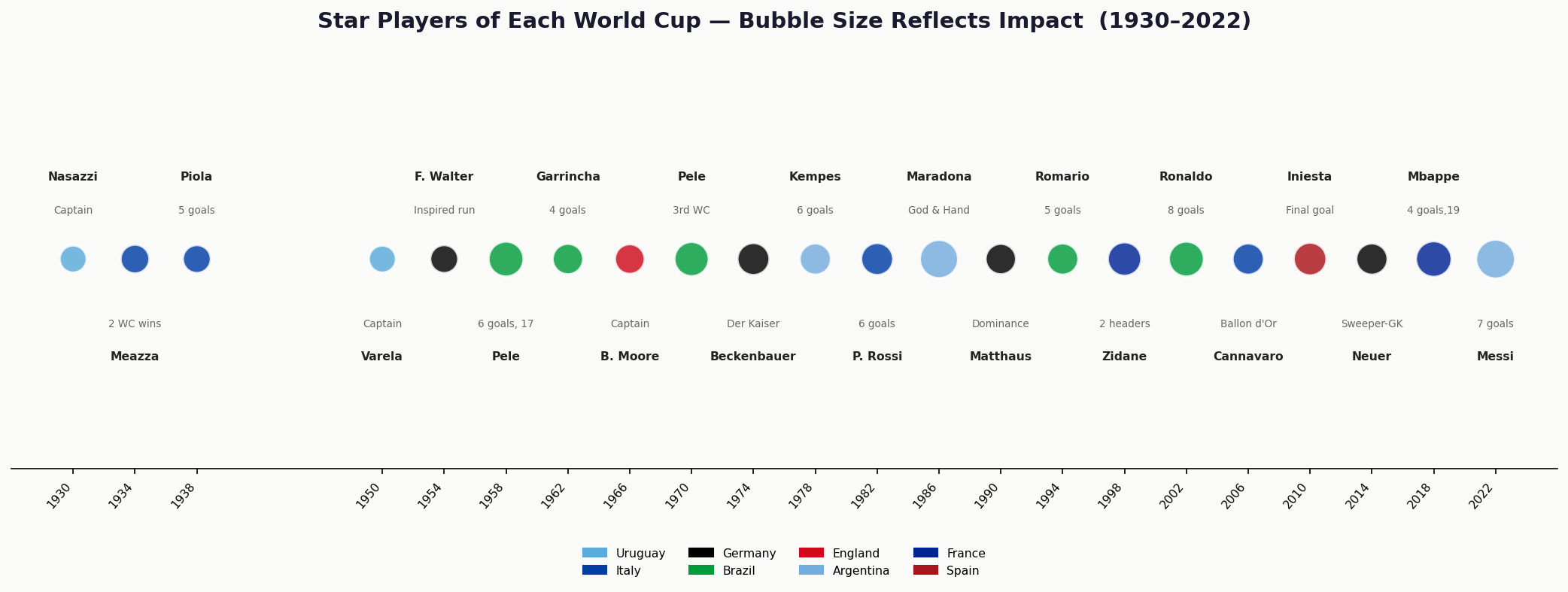
Figure 4: Star players of each World Cup from 1930–2022. Bubble size reflects overall impact on the tournament. Country colour-coded by nation.
|
Year |
Player |
Country |
Why They Were Immortalised |
|
1958 |
Pele |
Brazil |
6 goals at 17 years old. Hat-trick in semi, 2 in final. Youngest ever World Cup winner. |
|
1966 |
Bobby Moore |
England |
Lifted the trophy on home soil. Immaculate defending throughout. Pele called him the greatest. |
|
1970 |
Pele |
Brazil |
The complete footballer. Final goal vs Italy — team goal of the century. 3rd title. |
|
1974 |
Beckenbauer |
Germany |
'Der Kaiser' — sweeper-libero who redefined the role. Led Germany on home soil. |
|
1978 |
Mario Kempes |
Argentina |
6 goals including 2 in the final. The hero of Argentina's first ever title. |
|
1982 |
Paolo Rossi |
Italy |
6 goals in 3 matches after returning from suspension. Hat-trick against Brazil. |
|
1986 |
Diego Maradona |
Argentina |
The greatest individual World Cup ever played. Hand of God. Goal of the Century. 5 goals, 5 assists. |
|
1994 |
Romario |
Brazil |
5 goals, relentless movement. The brilliant striker who brought the trophy home after 24 years. |
|
1998 |
Zinedine Zidane |
France |
2 headers in the final to demolish Brazil 3-0. Orchestrated France's greatest moment. |
|
2002 |
Ronaldo |
Brazil |
8 goals including 2 in the final. The ultimate redemption after his 1998 fit. |
|
2010 |
Andres Iniesta |
Spain |
Scored the extra-time winner in the final vs Netherlands. Genius of the tiki-taka era. |
|
2014 |
Manuel Neuer |
Germany |
The sweeper-goalkeeper who redefined the position. Near-flawless throughout. |
|
2018 |
Kylian Mbappe |
France |
4 goals at 19. Became only the second teenager after Pele to score in a World Cup final. |
|
2022 |
Lionel Messi |
Argentina |
7 goals, 3 assists. Won the Golden Ball. Finally, at 35, completed football's greatest career. |
From the first final in 1930 — Uruguay 4-2 Argentina in Montevideo — to Messi's Argentina beating France on penalties in Qatar 2022, these are the 22 occasions when everything in world football came down to one match.
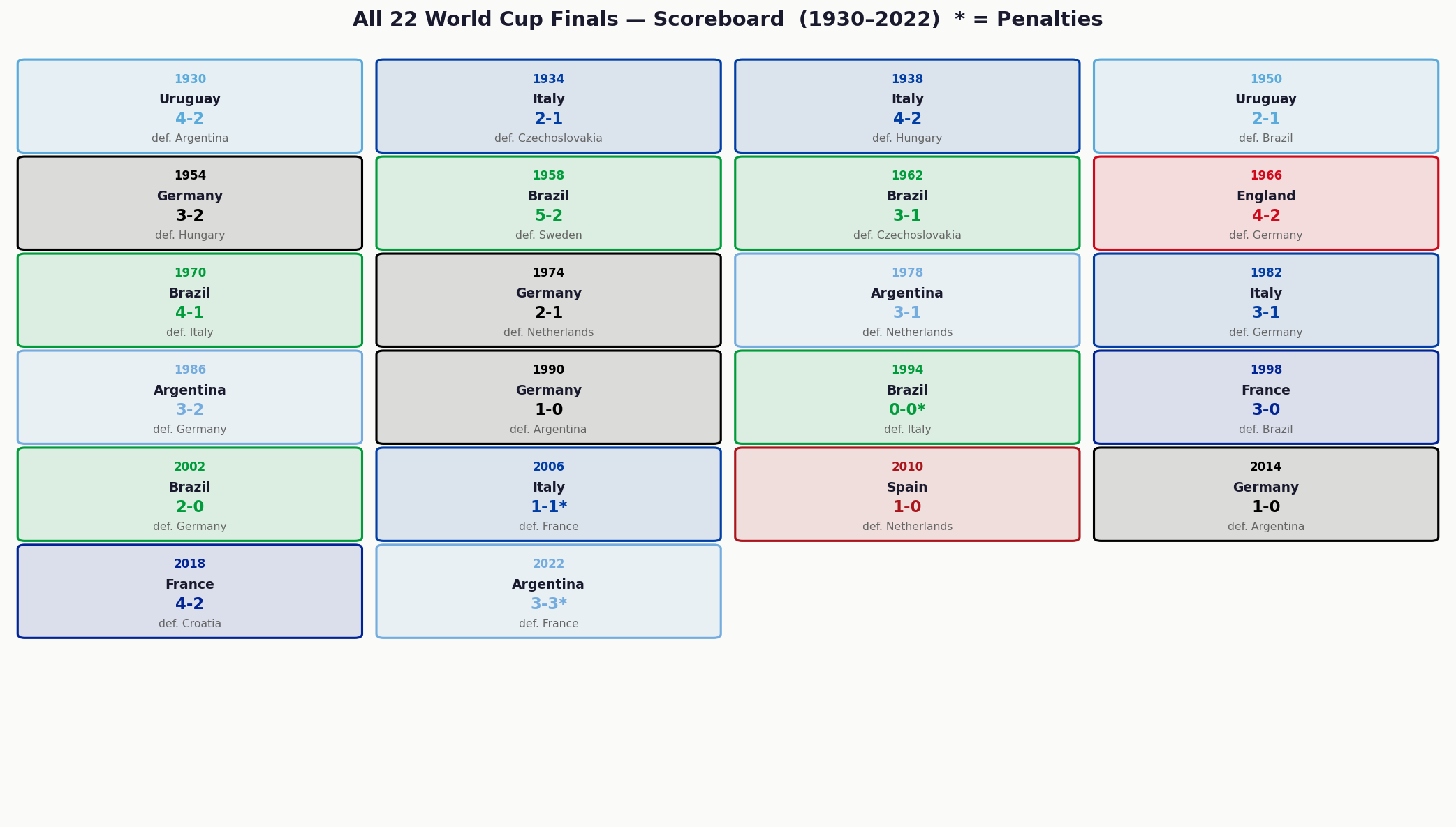
Figure 5: All 22 World Cup finals scoreboard (1930–2022). Colour-coded by winning nation. * = Decided on penalties.
Three finals have required a penalty shootout to separate the teams: Brazil vs Italy in 1994 (goalless after extra time), Italy vs France in 2006 (1-1), and Argentina vs France in 2022 (3-3 — the most dramatic of them all). Two finals ended 1-0 — Germany vs Argentina in 2014, and Spain vs Netherlands in 2010 — both in extra time.
The highest-scoring final remains Brazil's 5-2 victory over Sweden in 1958, while the most one-sided was France's 3-0 dismantling of Brazil in 1998 — a result that astonished the world given Brazil's tournament-long favourites tag.
The financial transformation of international football mirrors what happened in club football — accelerated by television rights, globalisation, and the explosion of transfer fees. Uruguay's 1930 champions were amateur players with day jobs. Argentina's 2022 World Cup winning squad was valued at approximately £1.2 billion.
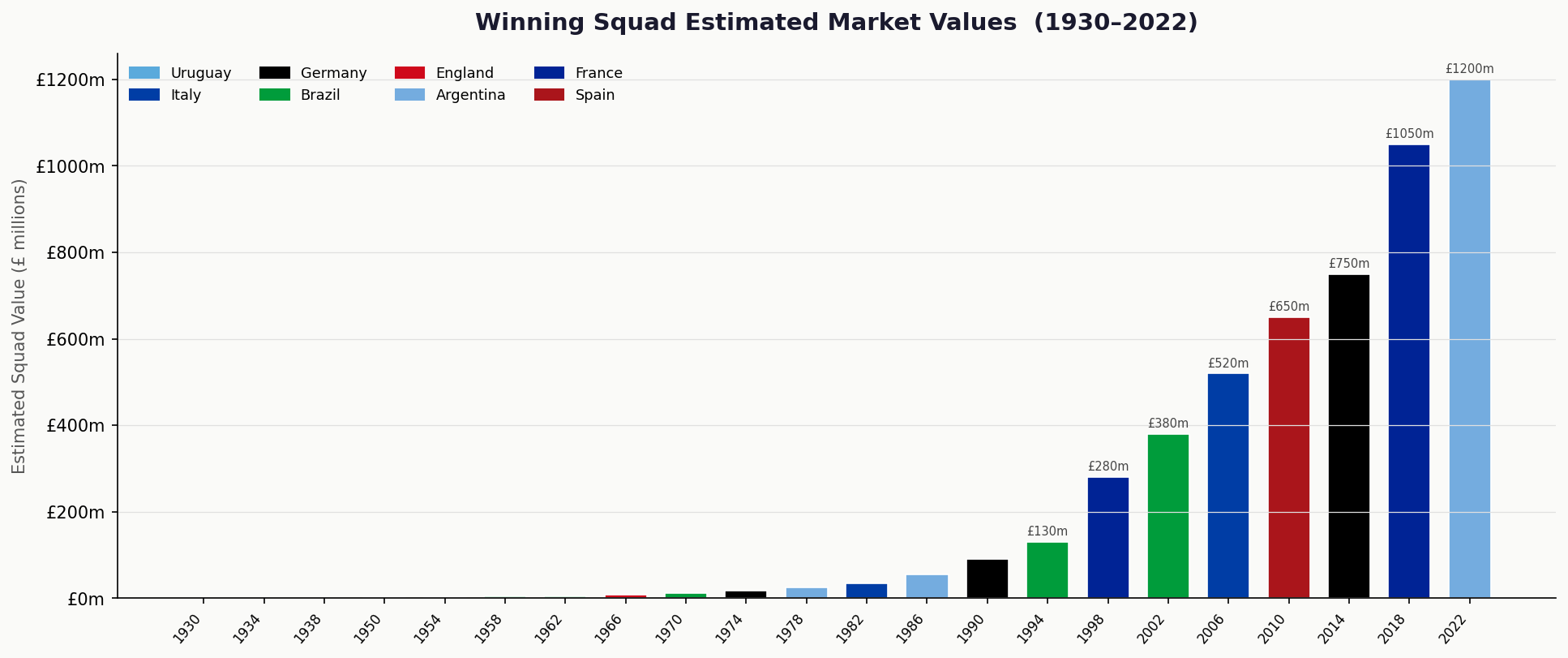
Figure 6: Estimated squad market values of each World Cup winning team (1930–2022). Values reflect contemporary transfer market prices. Pre-1990 values are small fractions of modern equivalents.
The step-change came in the 1990s with the Bosman ruling, the explosion of the Premier League, and Champions League money flowing into club football. France's 1998 winning squad was valued at around £280 million — by 2022, Argentina's squad was valued at more than four times that figure. The 2022 final pitted two squads worth a combined £2.2 billion against each other.
The World Cup began with just 13 teams in 1930, expanded to 16 teams from 1934, then made two major expansions: to 24 teams from 1982, and to 32 teams from 1998 — where it has remained ever since. From 2026, the World Cup in USA, Canada and Mexico will expand to 48 teams, fundamentally changing the nature of the competition.
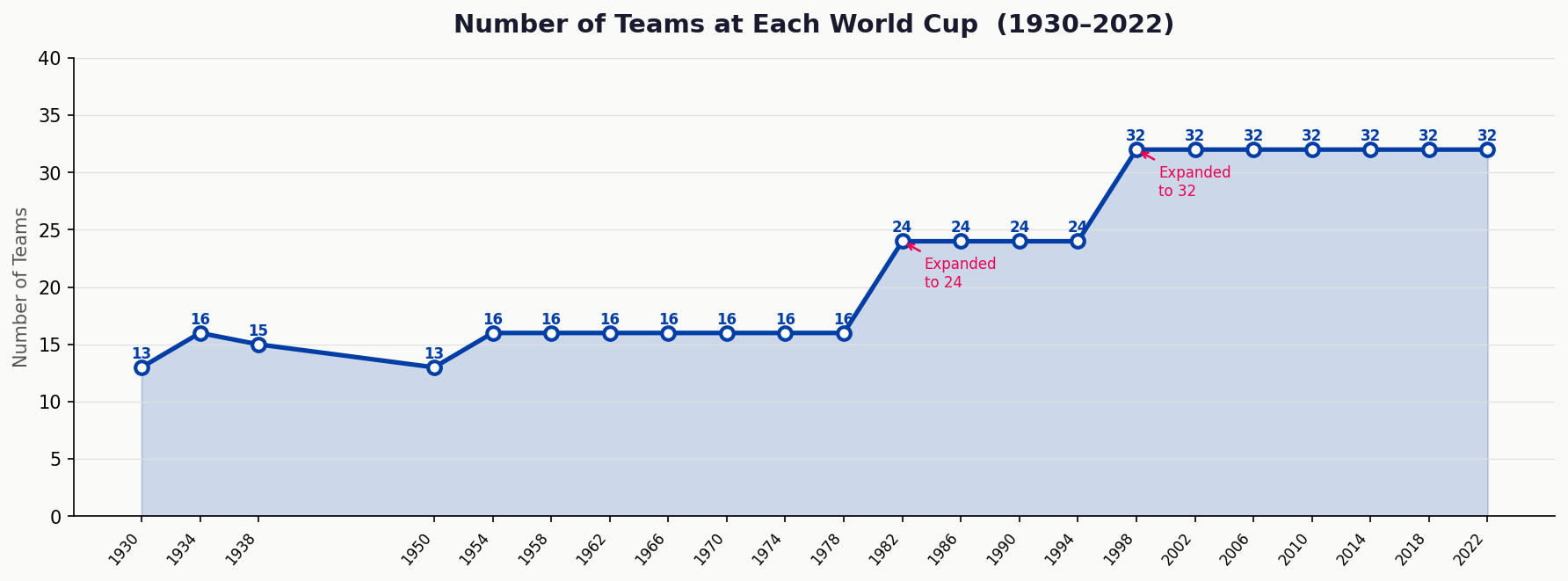
Figure 7: Number of teams competing at each World Cup (1930–2022). The two major expansions — to 24 in 1982 and 32 in 1998 — are annotated.
Each expansion has broadened access for nations from Africa, Asia, and the Americas. The 1982 expansion brought in teams like Algeria, who caused one of the tournament's great upsets by beating West Germany in the group stage. The 1998 expansion brought in the likes of Japan and South Africa, developing football's global footprint.
17 different countries have hosted the FIFA World Cup across 22 tournaments. Mexico and Germany are the only nations to have hosted twice (Germany as West Germany in 1974 and then as reunified Germany in 2006). Unusually, the co-hosted 2002 tournament between Japan and South Korea remains the only World Cup hosted by two nations, and the first held in Asia.
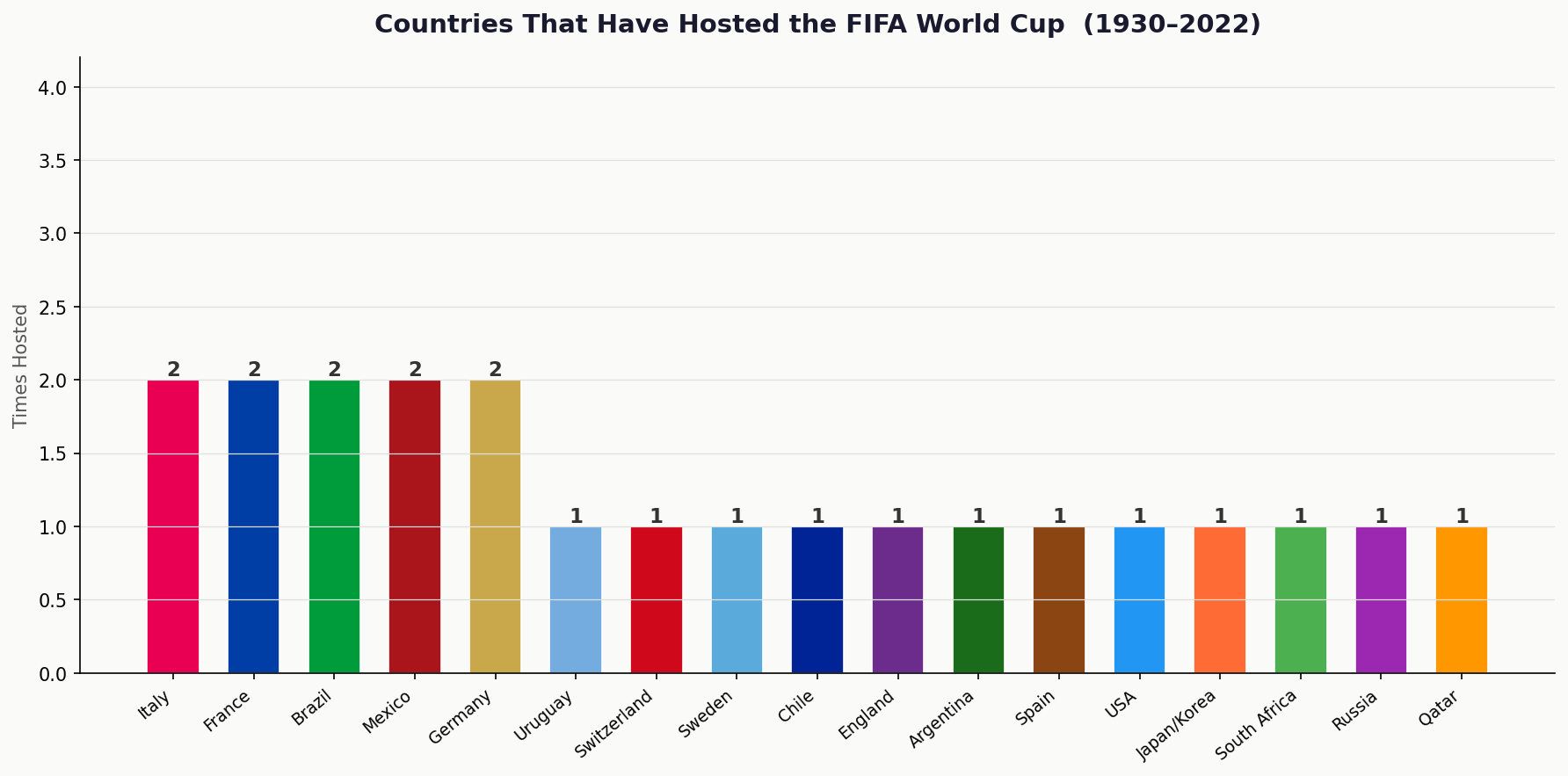
Six times, the host nation has gone on to win the trophy — Uruguay (1930), Italy (1934), England (1966), Argentina (1978), France (1998), and Germany (2006). Qatar 2022 was the first World Cup held in the Middle East, played in November-December to avoid the extreme summer heat. The 2026 World Cup will be jointly hosted by the USA, Canada and Mexico.
Across 22 tournaments and 92 years, these are the landmark achievements and statistics that define FIFA World Cup history.
|
Record |
Who |
Detail |
|
Most titles |
Brazil |
5 World Cup titles (1958,1962,1970,1994,2002) |
|
Largest final win |
Brazil v Sweden 1958 |
5-2 — Pele's coming-out party |
|
Most consecutive |
Italy 1934 & 1938 |
Only nation to win back-to-back World Cups |
|
Most appearances |
Germany/Argentina |
8 final appearances each |
|
Host wins |
Uruguay(1930), Italy(1934), England(1966), Argentina(1978), France(1998), Germany(2006) |
6 times the host nation won |
|
Record individual goals |
Miroslav Klose (Germany) |
16 goals across 4 World Cups (2002-2014) |
|
Youngest scorer |
Pele (Brazil) |
17 years old at 1958 World Cup, 6 goals |
|
Penalty drama |
1994 & 2006 & 2022 |
Three finals decided by penalty shootout |
The 2026 FIFA World Cup — to be held across the USA, Canada and Mexico — will be the biggest in history. With 48 teams for the first time, 104 matches across 16 host cities, and an estimated audience of five billion people, it will dwarf every previous tournament in scale.
The defending champions will be Argentina, who arrive in 2026 seeking back-to-back titles — something only Italy has ever achieved (1934 and 1938). Brazil will be hungry to end their 24-year wait for a sixth title, while France's young squad — with Mbappe now approaching his peak at 27 — will be among the favourites.
For the first time, England — last winners in 1966 — may arrive at a World Cup with genuine expectation rather than hope. A squad built around a new generation of talent has produced consistent performances, and the expanded format gives more opportunities to advance deep into the tournament.
The World Cup is football's greatest story. And in 2026, a new chapter begins — the biggest, most ambitious, most watched sporting event in human history.