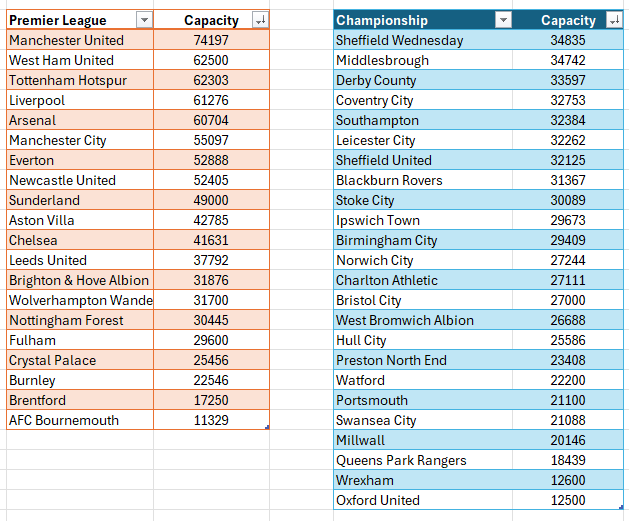
For as long as football’s been played in packed terraces and towering stands, there’s been an unspoken assumption that big stadiums equal big clubs. After all, it makes sense - more seats, more fans, greater atmosphere. But when you dig a little deeper, that idea starts to fall apart pretty quickly - let’s get into it.
On the surface, it seems logical. A larger ground can bring in more ticket income, create a louder crowd and boost the matchday buzz. Bigger crowds also often help with merchandise sales and can make a club more appealing to potential signings. No one’s denying that having 60,000 seats is useful. However, capacity is only one part of the story, and not even the most significant.
If size were only based on how many people you can squeeze into a stadium, then clubs like Sheffield Wednesday, Derby and Sunderland would routinely be considered giants in the game. Which, to give them credit in terms of fanbases and heritage, they absolutely hold their own. But football in 2025 is shaped by something much more powerful than numbers, and that’s money.
Just look at the Premier League’s top clubs by valuation. Manchester United sit at around £5.2bn, Liverpool at £4.2bn, and Manchester City generate some of the highest revenues in world football. These figures are way beyond that of most Championship clubs, not due to their ground size, but because of global reach, commercial deals and worldwide brand power.
City’s ground, for example, isn’t even the biggest in the league. Yet commercially and competitively, they’re one of the strongest clubs there is.
On the other side, the Championship offers a great reality check. You’ve got clubs with huge capacities - some over 30,000 - that still bring in a fraction of Premier League revenue. The average revenue for a Championship club is around £40 million a year, and no matter how many seats are filled, the financial disparity speaks for itself.
Yes, but only to a point. A big ground can help; it can create a brilliant atmosphere, allow for more ticket sales and support a strong local fanbase. But it doesn’t automatically make a club financially powerful or globally recognised - and it certainly doesn’t guarantee success on the pitch, either. Plenty of smaller-stadium teams have punched well above their weight, while bigger sides have struggled despite their capacity.
The truth is simple, whilst capacity can give a club a platform, it does not guarantee performance. It can enhance what they already have, but it doesn’t define it.
Once you look at the numbers, in both leagues, it’s clear that club size is far more than how many seats are bolted to concrete, and the table below will show exactly that.