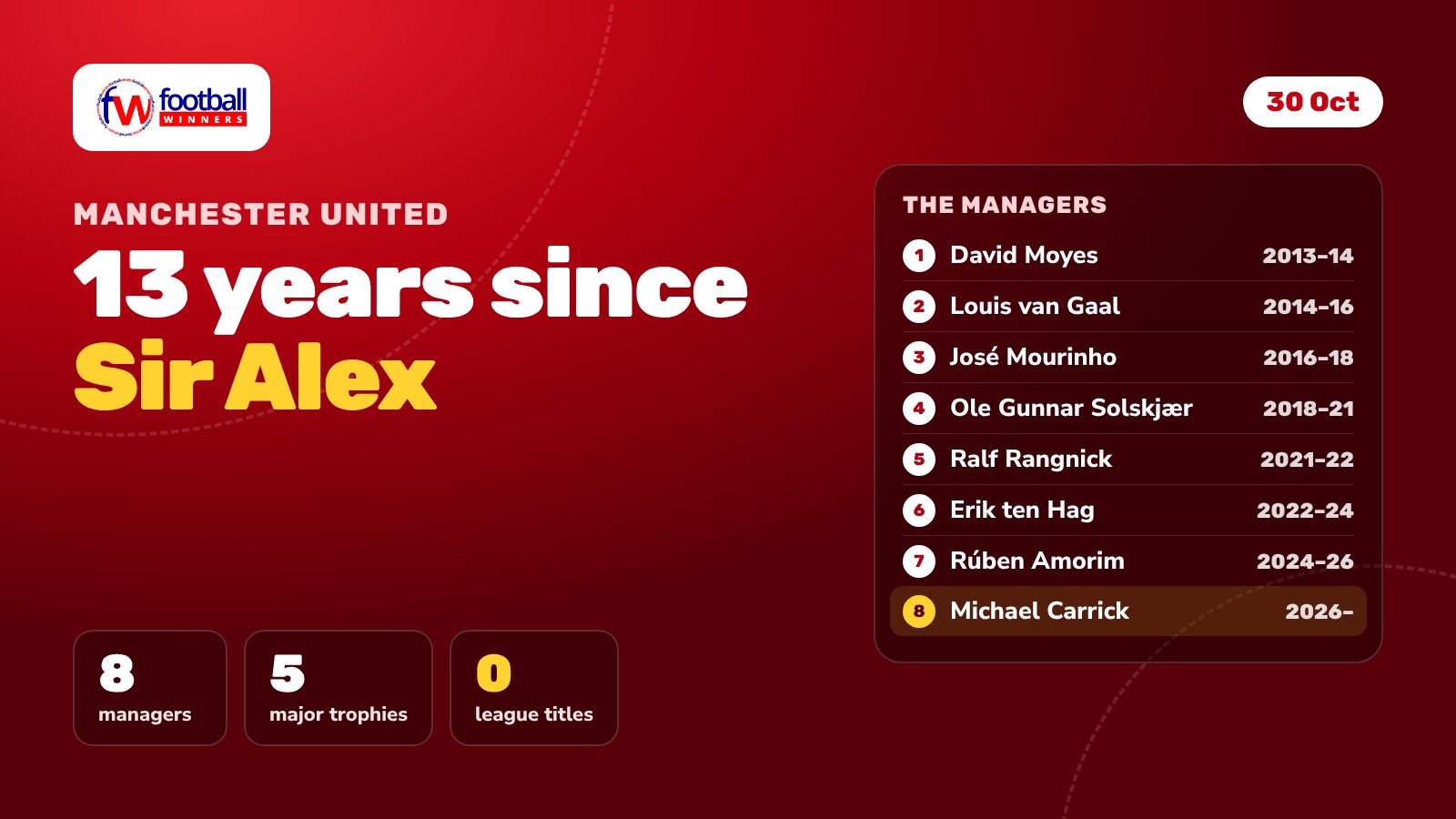
Eight managers, five trophies, no league title and a club still searching for itself. We look back at everything that has happened at Old Trafford since Sir Alex Ferguson walked away.
When Sir Alex Ferguson waved goodbye to Old Trafford in May 2013, he left behind a squad that had just won the Premier League by 11 points. It was the club's 20th league title and his 13th. "Your job now is to stand by our new manager," he told the crowd. Thirteen years on, United have stood by a lot of new managers, and none of them has come close to matching him.
The Chosen One and the Dutch philosopher
David Moyes was Ferguson's hand-picked successor, handed a six-year contract and the impossible task of following the most successful manager in British football. He lasted ten months. United finished seventh, missed out on Europe altogether and Moyes was sacked in April 2014 with four games still to play. Ryan Giggs saw out the season as caretaker.
Louis van Gaal arrived next, fresh from taking the Netherlands to a World Cup semi-final. His possession-heavy style was often slow and sterile, and fans grew restless, but he did bring a trophy. United won the FA Cup in May 2016, beating Crystal Palace after extra time. Van Gaal was sacked two days later.
Mourinho's silverware and the Solskjær years
José Mourinho was supposed to restore the winning habit, and at first he did. His first season brought the Community Shield, the League Cup and the Europa League, which also secured a place in the Champions League. In 2017/18 United finished second with 81 points, their best finish since Ferguson left, but they were still 19 points behind a record-breaking Manchester City. By his third season the mood had turned sour, with public rows with players and a flat style of play. He was sacked in December 2018.
Ole Gunnar Solskjær, the 1999 Treble hero, came in as caretaker and won his first eight matches. That was enough to earn him the job permanently. He took United to third and then second, and to the 2021 Europa League final, which they lost on penalties to Villarreal. He was never able to turn a good team into a winning one, though, and a 4-1 defeat at Watford in November 2021 ended his time in charge. Michael Carrick took temporary charge for three games, and remember that name.
Rangnick, Ten Hag and two more cups
Ralf Rangnick, the architect of the Red Bull football model, was appointed interim manager until the end of 2021/22. He was also meant to become a consultant afterwards, but that role never materialised. United finished sixth with 58 points, the lowest total of their Premier League era at the time, and Rangnick's warning that the club needed "open-heart surgery" became one of the defining quotes of the era.
Erik ten Hag's first season brought genuine optimism: third place, a return to the Champions League and the League Cup in February 2023, the club's first trophy in six years. The second season fell apart, with an eighth-place finish, the club's lowest since 1990. Yet he finished it by beating Manchester City 2-1 in the FA Cup final. It saved his job for a few more months, but after a poor start to 2024/25 he was sacked in October 2024.
Amorim's slide and Carrick's revival
Rúben Amorim arrived from Sporting with a big reputation and a fixed 3-4-3 system. His first season was the worst in living memory. United finished 15th, their lowest top-flight finish since they were relegated in 1974, and lost the Europa League final in Bilbao 1-0 to Tottenham. Big money was spent in the summer of 2025 on Matheus Cunha, Bryan Mbeumo and Benjamin Šeško, but the results never really followed. Amorim was sacked on 5 January 2026, a day after some pointed public comments about how the club was being run.
The man who stepped in was Michael Carrick, appointed as caretaker until the end of the season. He steadied the ship, got the best out of a squad that had looked lost, and led United back into the Champions League. In May 2026 he was given the job on a permanent basis.
The owners: Glazers and Sir Jim
Hanging over all of this has been the question of who owns the club. The Glazer family bought United in 2005 in a leveraged takeover that loaded the club with debt, and fan protests have rumbled on ever since. They peaked in 2021, when the club's part in the failed European Super League led to supporters storming Old Trafford and the game against Liverpool being postponed.
In late 2022 the Glazers put the club up for sale. Rather than a full sale, the outcome was a minority deal. In February 2024 Sir Jim Ratcliffe and INEOS bought around a quarter of the club and took control of football operations. What followed was a shake-up behind the scenes. Omar Berrada was brought in as chief executive and Jason Wilcox as technical director. Hundreds of staff were made redundant and ticket prices went up. There was also a headline plan for a new 100,000-seat stadium next to Old Trafford. Some of it has been welcomed, some of it heavily criticised, and the Glazers still own the majority of the club.
The scorecard
In 13 years United have won five major trophies: two FA Cups (2016 and 2024), two League Cups (2017 and 2023) and the 2017 Europa League. For most clubs, that would be a decent haul. For Manchester United, it sits alongside something unthinkable when Ferguson left: no league title for 13 seasons, and no serious title challenge in most of them. Well over £1 billion has been spent on transfers in that time, and some of the most expensive signings, from Ángel Di María to Antony, have become symbols of how much was spent and how little came back.
Where United stand today
As the end of October 2026 approaches, United are a club with Champions League football back at Old Trafford, a manager who understands the place and a squad that, on paper, is stronger than it was a year ago. But the start to 2026/27 has been bumpy. Carrick's position has come under scrutiny, and he has held talks with captain Bruno Fernandes to clear the air ahead of a big trip to Chelsea. That he is still in charge at all says something about how much he has rebuilt the club's belief since January.
The next chapter will depend on whether the club can finally give a manager the time and the structure that Ferguson enjoyed. Thirteen years ago, standing by your manager sounded like the easy part. Since then it has turned out to be the hardest thing for Manchester United to do.