
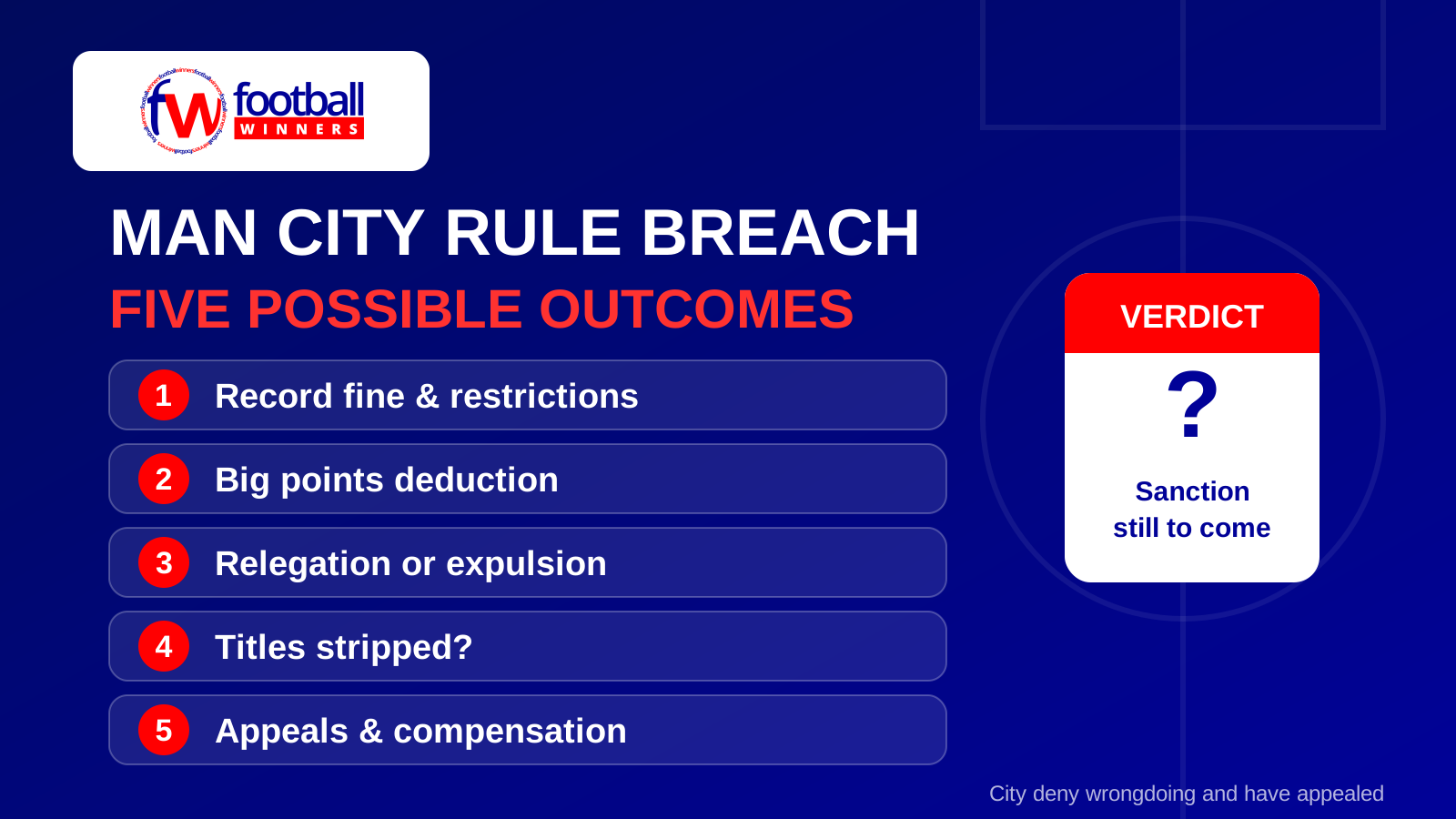
On 29 September 2026, the Premier League confirmed that an independent commission had found Manchester City in breach of the league's rules. It is the most significant ruling in English football for a generation, and it comes after a case that has run for more than three years. City deny any wrongdoing and have already appealed. No punishment has been decided yet.
This article sets out what the commission found, where the case stands today, and five scenarios for what might happen to City. The first half is fact, based on the Premier League's statement and the commission's published decision, with the club's response alongside. The second half is informed speculation, and we have labelled it as such.
What is the rule breach?
The case began in February 2023, when the Premier League referred Manchester City to an independent commission over alleged breaches of its financial regulations. The charges covered a long period, from the 2009/10 season through to 2017/18, plus a separate set of charges about the club's cooperation with the league's investigation from late 2018 onwards.
In simple terms, the Premier League's rules require clubs to give a true and accurate picture of their finances. Two sets of rules matter here. Profitability and Sustainability rules limit how much money a club can lose over a set period. Separately, Premier League rules require clubs to act in "utmost good faith" and to give accurate information when the league asks for it.
The commission's findings, as reported from the Premier League's statement and its published decision, centred on a few areas:
First, sponsorship income. The commission found that some sponsorship deals were not what they appeared to be. Income presented as commercial revenue from third-party sponsors was, in the commission's view, effectively funded by City's owners through Abu Dhabi United Group (ADUG), the club's ownership vehicle. That matters because related-party income has to be assessed at fair market value. Inflating it makes a club's finances look healthier than they were and lets it spend more than the rules allow.
Second, image rights and player payments. The commission found that payments to a former manager and to other figures, including money routed through a separate company, were not properly disclosed. The club's accounts therefore did not tell the full story of what it was paying its people.
Third, costs that were not recorded properly. The commission concluded that some expenses were hidden or misdescribed in the books, which again helped the club appear to be operating within the limits.
Fourth, and in many ways most seriously, cooperation. The commission found that City did not cooperate with the Premier League's investigation as the rules require, and it concluded that some witnesses were not honest in the evidence they gave. Rules about cooperation exist because the league has no police powers. It relies on clubs to hand over documents and tell the truth.
On the numbers, you will see slightly different figures in different places. The Premier League's statement says the club was found in breach on all of the financial charges and the majority of the cooperation charges. Some outlets have reported a tally of 114 of 115 charges, while others have put the overall sums involved at about £920 million. The Premier League itself refers to more than £900 million. We have stuck to the league's wording where I can and attributed other figures to the outlets that reported them.
What does Manchester City say?
City have consistently denied wrongdoing. Their position is that the case is politically motivated, that they have provided overwhelming evidence in their defence, and that they will pursue every available avenue. On 1 October 2026, the club filed an appeal against the findings.
It is worth being clear about what that means. A commission has made findings against the club. The club disputes them. Until the appeal is resolved, these are the commission's conclusions, not the last word.
Why did it take so long?
The charges were laid in February 2023. The hearing itself began in September 2024 and ran for around ten weeks. The decision then took almost two more years, and anyone expecting a quick answer has been disappointed several times over.
The scale of the evidence, the number of witnesses, the volume of legal argument and the fact that both sides have very well-funded legal teams all contributed. City's challenges to the Premier League's rules on commercial deals with companies linked to owners, known as associated party transactions, added a parallel legal fight that has also taken time.
Where does the case stand now?
There are three things to understand.
The appeal. Under the Premier League's rules, an appeal against a commission decision goes to an appeal board. On the timetable reported, the hearing needs to take place within 12 weeks of the appeal being lodged, which points to a deadline around 24 December 2026, and a decision is expected within 30 days of the hearing. That timeline could be extended, but it gives us a rough idea of when clarity might arrive.
Sanctions are separate. The commission's ruling is about whether rules were broken. What happens as a result is decided at a separate hearing, which is private. There is no tariff or sentencing grid in the Premier League rulebook. The commission has a list of possible sanctions under Section W of the rules and wide discretion in choosing among them.
The toolbox is broad. Under the rules, the options range from a reprimand and a fine through to points deductions, transfer restrictions and, at the extreme end, expulsion from the league. Expulsion would need the support of 15 of the Premier League's 20 clubs. There is no formal power to "relegate" a club as a punishment, but a large enough points deduction would have the same effect in practice.
Five scenarios: what might happen to Manchester City
None of the following is a prediction. The Premier League has not announced a sanction, and the commission has a very wide range of options. We have ordered the scenarios from the most likely to the most remote, in our own view, and we have tried to explain the reasoning and the obstacles for each.
Scenario 1: A record fine, with costs and restrictions
This is the least dramatic outcome and, on past form, the one that sits closest to precedent. The commission could impose a very large financial penalty, order City to pay the Premier League's legal costs, and restrict what the club can do in the transfer market, for example by limiting registrations or imposing tighter financial monitoring.
The argument for it is simple. Fines are the most familiar sanction, they are easy to enforce, and they avoid punishing players and supporters for the actions of executives. The argument against it is that a fine means very little to a club backed by one of the wealthiest owners in world football. A penalty that does not hurt invites criticism that the rules have no teeth, especially from rival clubs. Given that the commission found dishonesty in the evidence, we think a fine alone would be hard to defend as proportionate.
Scenario 2: A significant points deduction this season
This is the outcome many observers regard as the most plausible. The Premier League has used points deductions before. Everton were docked points in the 2023/24 season for breaching profitability and sustainability rules, a punishment that was cut on appeal but still had a real effect on their position. Nottingham Forest were later docked four points for a breach in the same area.
Those cases involved overspending by a few million pounds and were dealt with fairly quickly. The City case is on a completely different scale, in size, in duration and because it involves findings about dishonesty. Commentators and lawyers have floated deductions anywhere from a double-figure number to 40 or 60 points or more, though that is speculation and the commission is not bound by what has gone before.
A deduction would hurt City where it counts, on the table, but the effect depends on timing. A sanction applied to a season already under way could end City's title hopes, put a European place at risk or both. Applied to a future season, it could be less damaging, because City could plan for it.
Scenario 3: A deduction so large it means relegation, or expulsion
This is the headline scenario that fans of other clubs mention most, so it is worth treating seriously, and worth treating honestly. The Premier League's rules do allow for a very large deduction, and they do allow for expulsion. Relegation is not a named sanction, but a deduction big enough to leave a club in the bottom three produces the same result.
We think this is unlikely. Tribunals tend to be wary of sanctions so heavy that they are disproportionate or that would not survive an appeal, and any extreme penalty would be challenged immediately. Expulsion needs 15 of 20 clubs to vote for it, and the league would be exposed to enormous legal and commercial risk. The Premier League's broadcast deals, its sponsors and its overseas reputation would all be touched by the removal of one of its biggest names. That said, the commission found serious things, and we would not rule it out entirely. It is the outer edge of the possible range rather than the middle of it.
Scenario 4: Retrospective punishment, with titles in question
Because the breaches relate to seasons going back to 2009/10, one of the loudest questions is whether City could lose trophies won in that time, including Premier League titles. That is what many rival supporters want.
It is the least likely of the five. The Premier League's rules do not include a clear mechanism for stripping a title years after the event, and most legal commentators think it would be very hard to do. Retrospective punishment also raises obvious fairness issues, because the results on the pitch were real and the players and managers of the time had no part in the financial arrangements. There is also the question of whether a long-delayed case can be used to rewrite history. If any titles were to be affected, we would expect the matter to end up in front of a court. We include it because it is the question fans ask most, not because it is likely.
Scenario 5: A long legal fight, with compensation claims
The final scenario is not a sanction at all, but what is probably the most likely path in the real world: the case does not end with the commission.
City have appealed. If the appeal board upholds the findings, the club could go on to challenge the outcome in the courts, or via arbitration. Appeals have significantly changed outcomes before, as Everton's did, and City have the resources to fight every step.
Alongside that, there is the prospect of civil action. Reports suggest that several rival clubs, including Arsenal, Liverpool, Manchester United and Tottenham, have been looking at compensation claims on the basis that City's alleged overspending gained them a competitive advantage. Figures of more than £200 million have been mentioned in the press. Proving that a breach caused a specific loss in specific seasons would be very hard, and we would treat any number with caution.
The Football Association and UEFA both have their own rules and either could look at the findings. At the time of writing the FA has made a statement but has not announced any action, and UEFA's position is being watched closely.
If this scenario plays out, the honest answer to "what will happen to City?" will be "a lot of lawyers will be busy for a long time".
What we do not know
There are several important gaps. We do not know what sanction the commission will impose, or when. We do not know whether the appeal will succeed in whole or in part. We do not know how rival clubs and the football authorities will react, or whether any claims for compensation will be brought. And much of the commission's decision has been redacted, so the full evidence is not public.
It is also worth saying that people on both sides of this argument are not neutral. Supporters of City's rivals tend to want the harshest outcome, and City's supporters tend to want to see the club vindicated. Both groups can find a line in the headlines to confirm what they already believe. The most reliable approach is to wait for the sanction decision and the appeal ruling, and to read the primary sources rather than the commentary.
What it means for footballWinners players
The good news for anyone playing footballWINNERS is that none of this changes the game. footballWINNERS scores your picks on the results of the matches, not on where clubs sit in the table. A points deduction would change the league table, but a win on the pitch is still a win for your pick.
If you want to put your football knowledge to the test while the lawyers argue, you can make your ten picks for this week's games at footballwins.co.uk. It is free to play.
Sources: Premier League, "Premier League statement: Manchester City FC" (premierleague.com); the Commission's redacted Core Decision; Sky Sports, ESPN, Reuters, Al Jazeera, NBC and ITV coverage; The FA's statement.