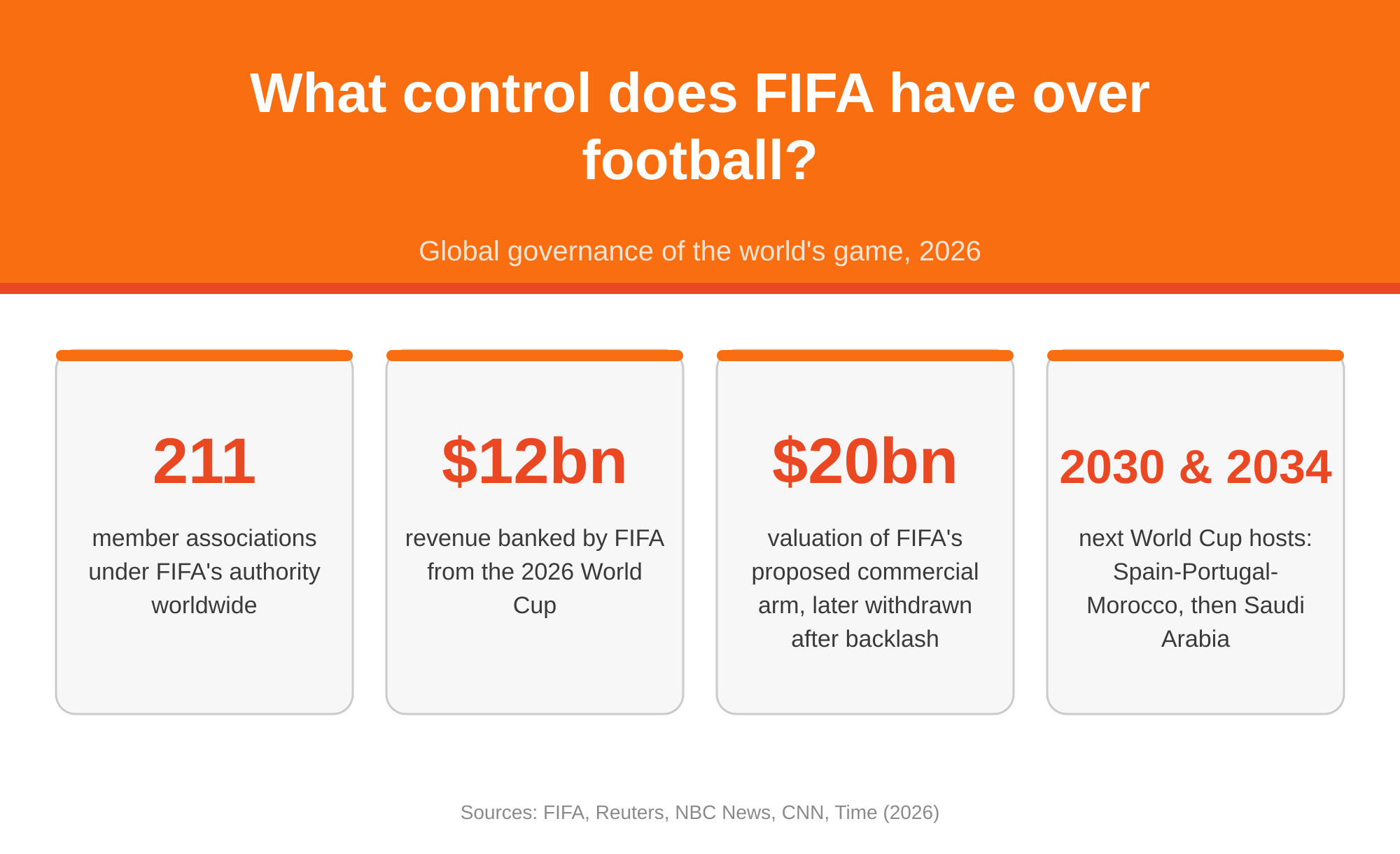
FIFA, the Fédération Internationale de Football Association, sits at the very top of world football's governance pyramid. Founded in 1904 and now encompassing 211 member associations, it holds authority that few global sporting bodies can match, and 2026 has shown just how far that control extends.
At its core, FIFA controls access to the game's biggest stage. No World Cup happens without FIFA's sanction, and it alone decides which nations host it, how qualification works, and how revenue is distributed. The 2026 World Cup, jointly hosted by the United States, Canada and Mexico, was FIFA's largest yet, generating record income of around $12 billion. When reports emerged that political figures might try to influence host-city decisions, FIFA officials were quick to assert that only FIFA determines where matches are played.
FIFA's reach goes well beyond staging tournaments. It sets the international match calendar that every national association and club must work around, writes the Laws of the Game alongside the International Football Association Board, and controls player eligibility and transfer regulations through its statutes. Member associations that fall foul of FIFA's rules, including government interference in national federations, can be suspended from all international competition.
This authority was tested dramatically in the summer of 2026. FIFA proposed a new commercial subsidiary, FIFA Forward Enterprise, to house the organisation's commercial and event operations, with plans to sell a minority stake to outside investors at a $20 billion valuation. FIFA insisted it would retain sole control and "exclusive authority" over governance, competitions and the match calendar. Even so, the plan drew immediate criticism from UEFA, CONCACAF, the Asian Football Confederation and England's Football Association, all of whom said they had not been consulted. Faced with the backlash and the threat of a boycott, FIFA president Gianni Infantino withdrew the proposal, a rare example of FIFA's own stakeholders pushing back against its authority.
The episode illustrates the central tension in FIFA's power. It holds a near-global regulatory monopoly, distributes development funding that many national associations depend on, and uses a one-country-one-vote system that lets it build broad political coalitions. Confederations like UEFA control competitions and commercial arrangements within their own regions, but ultimate recognition, and access to FIFA's competitions, still runs through Zurich.
Looking ahead, FIFA's control shows no sign of loosening. With the 2030 World Cup set for Spain, Portugal and Morocco and Saudi Arabia already confirmed as 2034 host, FIFA continues to shape the game's calendar, finances and global structure for years to come, even as clubs, leagues and governments increasingly test the limits of that authority.